Mondelēz sues vegan chocolate maker over Toblerone shape
Mondelēz International has filed a High Court lawsuit against British vegan brand Catherine's Originals, alleging its O'bar product infringes the trademark of Toblerone's distinctive segmented shape.
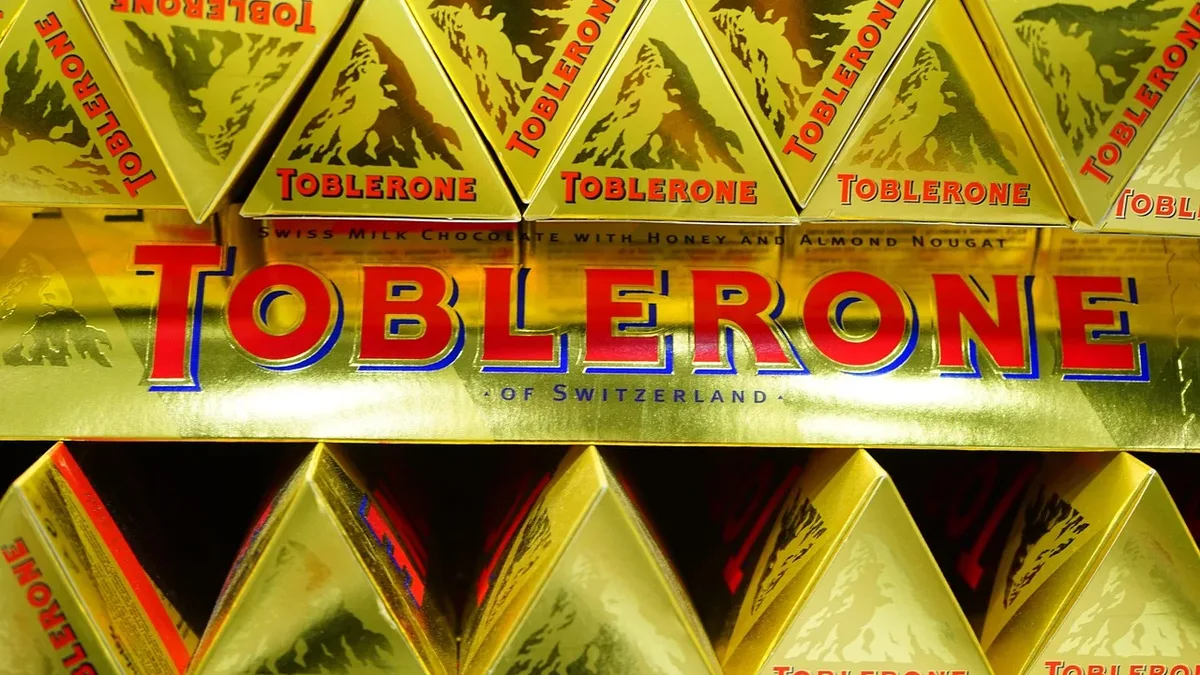
Mondelēz International is suing British vegan chocolatier Catherine’s Originals over the shape of its O’bar product. The confectionery giant filed papers at the High Court of England and Wales on 15 October 2026, alleging trademark infringement and passing off.
Mondelēz, the owner of Toblerone, claims the vegan O’bar’s design too closely resembles its iconic product. The dispute centres on the O’bar’s long, flat piece of chocolate topped with a series of rounded, semi-oval segments. Mondelēz argues this could lead consumers to assume a commercial link between the two brands.
Background of the brands
Catherine’s Originals was founded by Catherine Dodd in 2021 and produces premium vegan chocolate. The small brand, based in West Sussex, offers a range of dairy-free products including the O’bar. The O’bar range features 200g chunky sharing bars with rounded segments, available in several flavours.
Toblerone, one of Mondelēz’s best-known products, is famous for its chunky triangle shape inspired by the Swiss Alps. Its prism shape has been protected by a trademark in the UK since 1929.
The legal arguments
A Mondelēz spokesperson stated the company has a responsibility to protect its trademarks and intellectual property, which it takes seriously. The spokesperson added that attempts to resolve the matter constructively with Catherine’s Originals over several months had failed.
The ongoing case is listed as a passing off and trade marks dispute. Mondelēz alleges the product infringes its trademark rights in Toblerone’s distinctive shape. For many brands, visual cues like a product’s shape are key to consumer recognition and become valuable intellectual property assets.
Legal experts note shape trademarks are often interpreted narrowly. Michael Conway, an intellectual property lawyer at Birketts, said the court would need to assess similarity. He added that where a mark enjoys Toblerone's reputation, consumers may not need to be confused about the source. If another shape is sufficiently similar to evoke the Toblerone mark and create a link in the consumer's mind, it may support an infringement claim.
Catherine’s Originals responds
Catherine’s Originals rejects the claims and plans a legal defence. The company stands firmly behind the product and identity it has created. Founder Catherine Dodd strongly disagrees with the claim, stating the bars were clearly and deliberately O-shaped. She said the design was inspired by the 'O' in Catherine's Originals and features smooth curved edges.
Dodd has accused Mondelēz of attempting to intimidate a small independent business into folding. The company considers O’bar to have its own distinctive design and identity and states it has no commercial affiliation with Toblerone or Mondelēz.
Context and market position
It is quite rare for a brand owner to sue another over the shape of a product, according to Laurie Bray, a senior associate trade mark attorney. This lawsuit highlights the ongoing importance of protecting distinctive confectionery trademarks, especially with the rise of ‘dupe culture’ where consumers seek lower-cost alternatives similar to premium goods.
However, Catherine’s Originals’ vegan bar does not fall into a lower-cost category. A comparison of the 200g bars shows a significant price difference.
| Product | Brand | Typical Retail Price |
|---|---|---|
| O'bar | Catherine's Originals | Starts at £9.20 |
| Toblerone | Mondelēz | Around £4.20 |
Toblerone’s shape has been at the centre of trademark disputes before. In 2017, Mondelēz challenged Poundland’s Twin Peaks chocolate bar. That dispute was eventually settled after changes were made to the product’s packaging and shape. Poundland re-released the product in 2018 with smaller hills.
This is not the only recent lawsuit from Mondelēz. Last year, the company filed a lawsuit against retail chain Aldi in an Illinois court, claiming the retailer copied packaging designs for several of its well-known cookie and cracker brands.
The allegations in the current case have not yet been tested in court and no judgment has been issued. Even with a trademark registration, it could be challenging for Mondelēz to prove the O’bar is sufficiently similar to cause customer confusion. As a much smaller manufacturer, a lengthy court battle may be daunting for Catherine’s Originals. Mondelēz could decide to appeal if the High Court’s decision does not go its way.
The case will be heard in the High Court of England and Wales.